
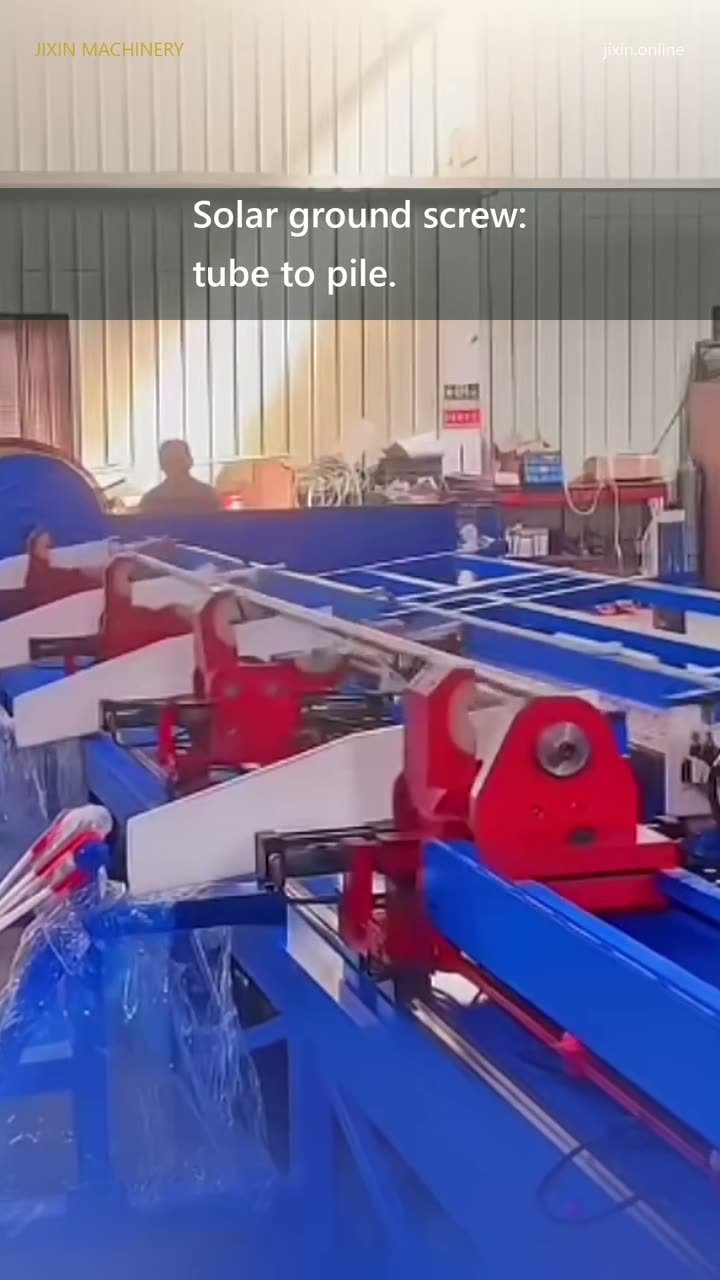

Line overview
A solar ground screw production line normally has four stages: tube cutting, tip tapering, spiral blade welding and surface treatment. The two stages that decide output and quality are tapering and welding. Everything else can be buffered with stock.
Buyers often try to solve both stages with one supplier and one budget. That works only if the supplier actually builds both machines. Jixin builds the tapering machine and the spiral welding machine, which means the two stations can be specified against the same tube drawing and the same cycle time target.
Tapering station
The tapering machine takes the cut tube, heats the tip zone and forms a uniform cone. For solar ground screws the typical requirement is a sharp, symmetric point with a taper length matched to the installation torque. A stepped or blunt point increases driving resistance and can deform during installation.
Automation matters here because ground screw orders are large and repetitive. Automatic feeding, forming and discharge let one operator run the tapering station while supervising the welder. The L-160×600 CNC is the model most buyers start with for photovoltaic piles: Ø160 mm maximum diameter, 7 mm maximum wall, 600 mm die length and automatic feeding.
Welding station
The spiral blade is welded to the tapered shaft. The welding station controls the pitch, the position of the first and last blade, and the weld quality at the blade-to-pipe joint. A dedicated spiral welding machine with a rotating fixture produces a consistent pitch; manual welding produces variation that shows up as installation torque differences on site.
Ask for the welding cycle time and the consumable cost per piece. Then check the straightness of the finished screw. A screw that is straight after welding saves time at the galvanising stage and installs faster.
Layout and manpower
Lay the line out in process order with a buffer between tapering and welding. Tapering is usually faster than welding, so the buffer prevents the welder from waiting. A two-person crew can typically run cutting, tapering and welding with one person on the welder and one moving material and inspecting.
Leave space for a jib crane or a roller conveyor at the welding station. Ground screws are long and awkward; handling is often the real bottleneck, not the machine.
Quality control points
Four checks cover most of the risk: taper diameter at three points, taper length, weld visual inspection and straightness. Add a torque test on a sample if the customer specifies installation torque. Record the results by batch so a complaint can be traced to a production window.
If the screws will be galvanised, check that the weld is clean and free of spatter before the parts leave the line. Galvanising hides nothing.
Capacity and ROI
Calculate capacity from the slower of the two stations, not from the fastest. If tapering runs 600 pieces per shift and welding runs 400, the line output is 400. Adding a second welder is often cheaper than adding a faster taper machine.
Build the case on cost per finished screw: tube, blade, welding wire, labour, energy and scrap. Then compare with the installed cost of the line. Buyers who model only the machine price usually underestimate the labour and handling share.
Frequently asked questions
Do I need two machines for a ground screw line?
Yes for most layouts: one tapering machine and one spiral welding machine. Some very small workshops outsource one stage, but that adds handling and lead time.
What diameter can the tapering machine handle?
The L-160×600 CNC handles up to Ø160 mm with 7 mm wall. Larger ground screws can be quoted on the Ø320 mm platform.
How many operators does the line need?
A typical two-person crew runs cutting, tapering and welding, with handling often being the limiting factor rather than the machines.
Talk to an engineer on WhatsApp
Send your tube drawing, material and target output. We will reply with a machine configuration, a measured sample plan and a factory quotation. WhatsApp +86 183 0020 2909 or email info@jixin.online.
Chat on WhatsApp